Every ambitious digital project — a SaaS product, a mobile app, an ERP rollout, an AI initiative — lives or dies on one decision made before a single line of code is written: which IT company you choose to build it.
Pick the right partner and you get software that ships on time, scales under load, and pays for itself. Pick the wrong one and you inherit blown budgets, missed deadlines, and a codebase nobody wants to touch. Industry research consistently shows that a large share of software projects fail not because of technology, but because of poor vendor selection and misaligned expectations.
If you are a CEO, founder, CTO, or business head evaluating development partners right now, this guide walks you through exactly how to choose the best IT company for your project — the criteria that matter, the red flags to avoid, and the questions that separate genuine engineering partners from resume-driven body shops.
Why Choosing the Right IT Company Matters More Than Ever
In 2026, software is no longer a support function — it is the business. Your invoicing, HR, customer experience, and increasingly your AI capability all run on the systems your technology partner builds.
That means the cost of a wrong choice is no longer just a failed project. It is:
- Lost market timing — a 6-month delay can hand the opportunity to a competitor
- Technical debt — poorly architected systems that cost 3–5x more to fix later
- Security and compliance exposure — GDPR, DPDP, HIPAA, PCI-DSS violations carry real penalties
- Team burnout — internal teams stuck firefighting a vendor's mistakes
The right IT company, on the other hand, behaves less like a vendor and more like a co-owner of your business outcome. Here is how to find one.
10 Criteria to Evaluate Before You Sign With Any IT Company
1. Proven Track Record — Not Just a Portfolio Page
Anyone can publish a portfolio. What you want is evidence of live products in production, verifiable client reviews, and case studies that describe the business problem, the solution, and the measurable result.
Ask every shortlisted company:
- Can you show me 2–3 products currently live and in daily use?
- Can I speak to a reference client in my industry or of my company size?
- Are your reviews verifiable on Google, Clutch, or GoodFirms?
A company confident in its delivery will say yes to all three without hesitation. For example, Datasoft Technologies publishes real, verifiable client reviews (4.9/5 on Google) and documented case studies of shipped products — from B2B travel portals to full HRMS platforms — rather than anonymous mockups.
2. Relevant Domain & Industry Expertise
Generic developers write generic software. A partner with experience in your industry already understands the compliance rules, workflows, and edge cases that would otherwise cost months of discovery.
- Building in healthcare? Look for HIPAA-aware experience.
- Fintech? PCI-DSS-aligned payment and lending systems.
- Manufacturing? ERP, MES, and inventory depth.
Check whether the company has dedicated industry solutions — not just a services list — and whether their case studies map to your domain.
3. Full-Cycle Capability: From Discovery to Post-Launch Support
A common leadership mistake is hiring a company that only codes. Real projects need:
- Discovery & requirement engineering — turning your vision into a buildable spec
- UI/UX design — because users judge software in seconds
- Development & QA — agile sprints with demos you can actually see
- DevOps & deployment — CI/CD, cloud infrastructure, monitoring
- Post-launch support — bug fixes, scaling, and feature evolution
If a vendor cannot own all five stages, you become the integrator — and integration risk lands on your desk. End-to-end partners like Datasoft Technologies cover the full spectrum, from custom software development and UI/UX design to cloud & DevOps and dedicated post-launch support, so a single accountable team carries your project from idea to scale.
4. Modern, Future-Ready Technology Stack
Ask what they build with — and why. Strong companies choose proven, maintainable stacks (Laravel, React, Node.js, Flutter, Python) and can articulate trade-offs, not buzzwords.
In 2026, also ask about AI capability. Even if your current project isn't AI-driven, your next one probably will be. A partner already delivering AI solutions and generative AI development will future-proof your investment instead of forcing a vendor switch in two years.
5. Transparent Pricing & Realistic Estimates
Beware of two extremes:
- Suspiciously cheap quotes — they almost always convert to change requests, delays, or abandoned projects
- Vague "it depends" pricing — a sign of weak estimation discipline
The best IT companies give you a structured estimate with assumptions stated, milestone-based payments, and clarity on what happens when scope changes. Some go further and publish free estimation tools — Datasoft, for instance, offers a public software development cost calculator and a mobile app cost calculator so leaders can pressure-test budgets before the first call.
6. Communication, Time Zones & Accountability
Projects rarely fail over a single bad decision — they fail over a hundred unanswered messages. Evaluate:
- Will you have a dedicated account manager or single point of contact?
- What is the sprint demo / reporting cadence?
- Is there real time-zone overlap with your business hours?
This matters especially for international clients working with offshore teams. The strongest offshore models pair an India engineering hub (for cost-efficient, senior talent) with an accountable local presence — the way Datasoft combines its Delhi NCR engineering hub with a Dublin client-operations office covering EU, UK, and US time zones.
7. Security, Compliance & IP Protection
Before sharing your idea or data, verify:
- NDA and IP assignment — you must own 100% of the code and product
- Compliance readiness — GDPR, DPDP (India), and industry-specific standards
- Security practices — secure coding, access controls, and testing protocols
- Certifications — ISO-certified delivery processes are a strong positive signal
Any hesitation here is disqualifying. Your software is a business asset; treat its custody accordingly.
8. Scalability of Engagement — Can They Grow With You?
Your needs will change. Today you need an MVP; next year you may need a dedicated team of eight. Prefer partners offering flexible engagement models:
- Fixed-price projects for well-defined scopes
- Time & material for evolving products
- Dedicated developers and team augmentation when you want direct control
Bonus points for low-risk entry options — Datasoft, for example, offers pre-vetted developers with transparent rates and a 14-day risk-free trial, which removes most of the downside of testing a new partner.
9. Business-First Thinking, Not Feature-First Thinking
The best question to ask in the first meeting is simple: "How will you measure whether this project succeeded?"
- A weak vendor answers with deliverables: "We'll build the features on time."
- A strong partner answers with outcomes: "We'll reduce your invoice processing time by 60%" or "We'll get you to first paying customer within 90 days."
Companies that align technology with measurable business outcomes consistently deliver more value per rupee, dollar, or euro spent.
10. Post-Launch Support & Long-Term Partnership
Software is never "done." Ask about:
- Warranty period for bug fixes after go-live
- SLA for support response times
- Roadmap and enhancement engagement after launch
The companies worth choosing measure success in years of partnership, not invoices. Look for long-standing client relationships — a company retained as an exclusive IT partner by its clients (as Datasoft is for the PAYLAP Group) is showing you exactly the behaviour you want after your own launch.
7 Red Flags That Should End the Conversation Immediately
- No verifiable reviews or references — only screenshots and claims
- Quotes without questions — a company that prices your project without deep discovery doesn't understand it
- "Yes" to everything — genuine experts push back on bad ideas
- No named point of contact — accountability will vanish when problems appear
- Refusal to sign an NDA or assign IP — walk away
- Portfolio full of templates — cloned designs signal cloned thinking
- Pressure to pay large amounts upfront — milestone-based payments protect both sides
The 7-Question Checklist for Your First Vendor Call
Print this and use it on every discovery call:
- Show me a live product you built that is similar to my project. Who uses it today?
- Who exactly will work on my project — and can I meet them before signing?
- What is your development process, and how often will I see working software?
- How do you handle scope changes and what do they cost?
- What security and compliance standards do you follow?
- What happens in the 6 months after launch?
- Why do your longest-standing clients stay with you?
The quality — and honesty — of the answers will tell you more than any sales deck.
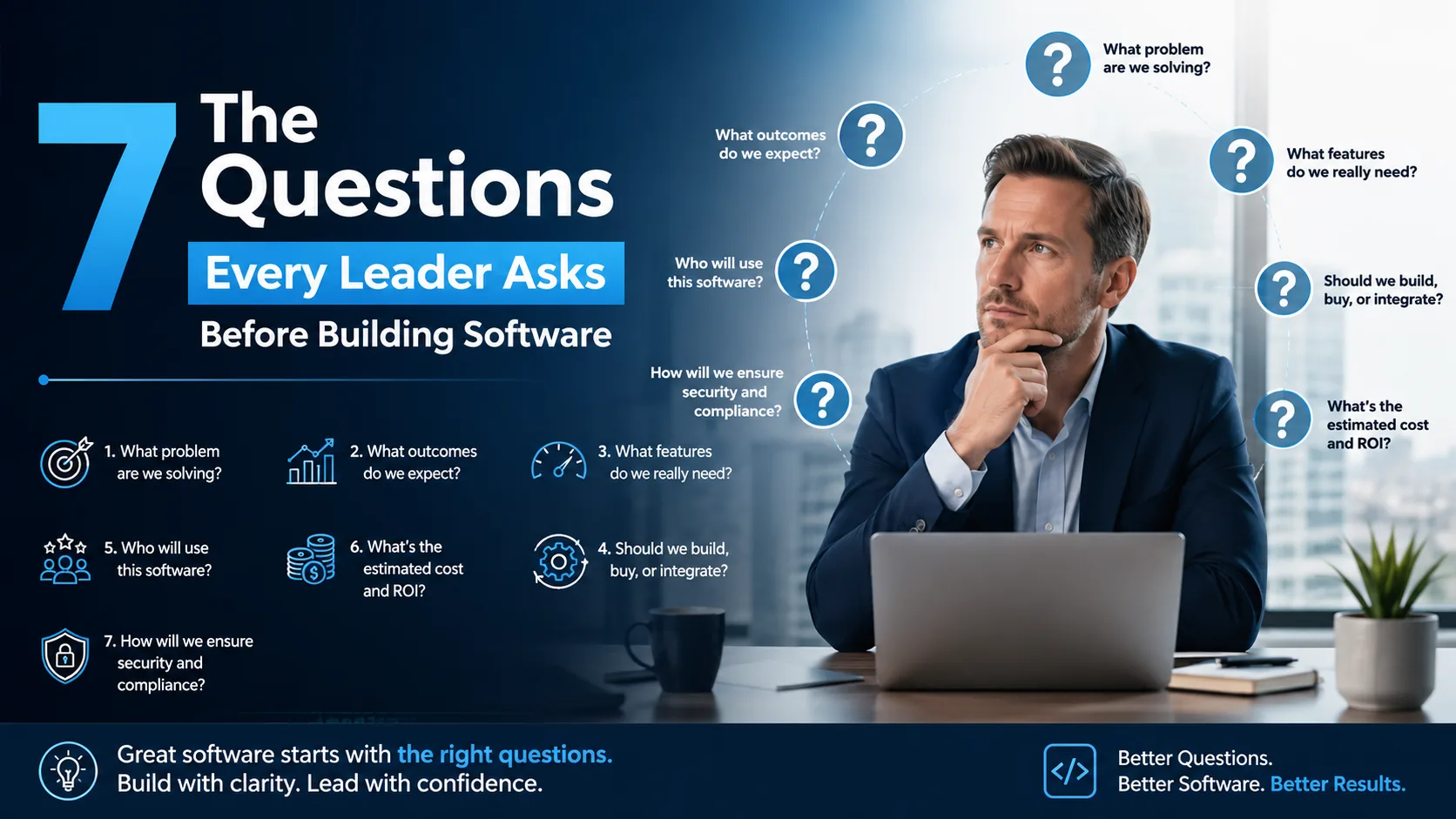
(For a deeper dive into pre-project decision-making, see our related guide: The 7 Questions Every Leader Asks Before Building Software.)
Why Leaders Across 8 Countries Choose Datasoft Technologies
If you apply every criterion in this guide, you will end up with a very short list — and Datasoft Technologies is built to be at the top of it.
Since 2016, Datasoft has delivered 250+ projects for 150+ clients across India, the USA, UK, Ireland, UAE, Australia, Singapore, and Canada — including brands like Bosch, Escorts, Jaquar, JBM Group, Shriram Finance, and Mahindra Tractors. Here's how Datasoft maps to the checklist above:
| What Leaders Look ForWhat Datasoft Delivers | |
| Proven track record | 4.9/5 verified Google reviews, live products in production, documented case studies |
| Full-cycle capability | Discovery → design → development → cloud/DevOps → post-launch support, under one roof |
| Industry depth | Healthcare, fintech, manufacturing ERP, logistics, real estate, HRMS, SaaS & AI |
| Modern stack + AI readiness | Laravel, React, Node.js, Flutter, Python plus dedicated AI & ML engineering |
| Transparent pricing | Free public cost calculators, milestone-based payments, no hidden charges |
| Global accountability | India engineering hub + Dublin EU operations, real-time overlap with EU/UK/US/APAC hours |
| Security & compliance | ISO-certified delivery, GDPR & DPDP-ready contracts, full IP assignment |
| Flexible engagement | Fixed-price, T&M, and dedicated developers with a 14-day risk-free trial |
| Long-term partnership | Dedicated account managers, 24/7 global support, multi-year exclusive client partnerships |
Most importantly, Datasoft leads with a business-first technology approach: every engagement starts with your outcomes — revenue, efficiency, market timing — and works backwards to the right technology, not the other way around.
Final Word: Choose a Partner, Not a Vendor
Choosing the best IT company for your project comes down to one shift in mindset: stop shopping for the cheapest coder and start selecting a long-term engineering partner who is accountable for your business result.
Use the criteria. Ask the seven questions. Watch for the red flags. And when you're ready to talk to a team that checks every box:
👉 Book a free discovery call with Datasoft Technologies — a no-obligation consultation where senior engineers (not salespeople) help you scope your project, estimate realistically, and plan your roadmap.
You focus on growth. Let the right partner handle the technology.
Frequently Asked Questions (FAQ)
Q1. What is the most important factor when choosing an IT company? A verifiable track record of live, in-production software combined with transparent communication. Everything else — pricing, stack, size — matters less if the company cannot prove it ships real products and keeps clients long-term.
Q2. Should I choose a local IT company or an offshore development partner? The best of both worlds is a hybrid model: an offshore engineering hub (like India) for senior talent at competitive rates, paired with an accountable local or same-time-zone presence for communication and contracts — the model Datasoft runs with its India + Dublin structure.
Q3. How much does it cost to hire a software development company in India? Costs vary by scope, complexity, and team size. Use a structured estimator such as Datasoft's free software development cost calculator to get a realistic baseline before requesting quotes.
Q4. How do I protect my idea when talking to IT companies? Sign an NDA before detailed discussions, and ensure the contract assigns 100% of the IP and source code to you. Reputable companies offer both by default.
Q5. What questions should a CEO ask before hiring a development company? Ask to see live products, meet the actual team, understand the sprint and reporting cadence, clarify scope-change handling, verify security compliance, and confirm post-launch support terms. The seven-question checklist in this article covers all of them.
Datasoft Technologies is an ISO-certified SaaS, custom software & AI development company headquartered in Delhi NCR, India, with an EU operations office in Dublin, Ireland — trusted by 150+ clients across 8 countries since 2016. Explore all services →
Categories:
Written by
Brijesh Vamdev
Part of the team at Datasoft Technologies, an AI-focused software development and IT consulting company delivering custom software, AI solutions, and SaaS platforms since 2016 across India, the USA, UK, and Ireland.
Work with our team