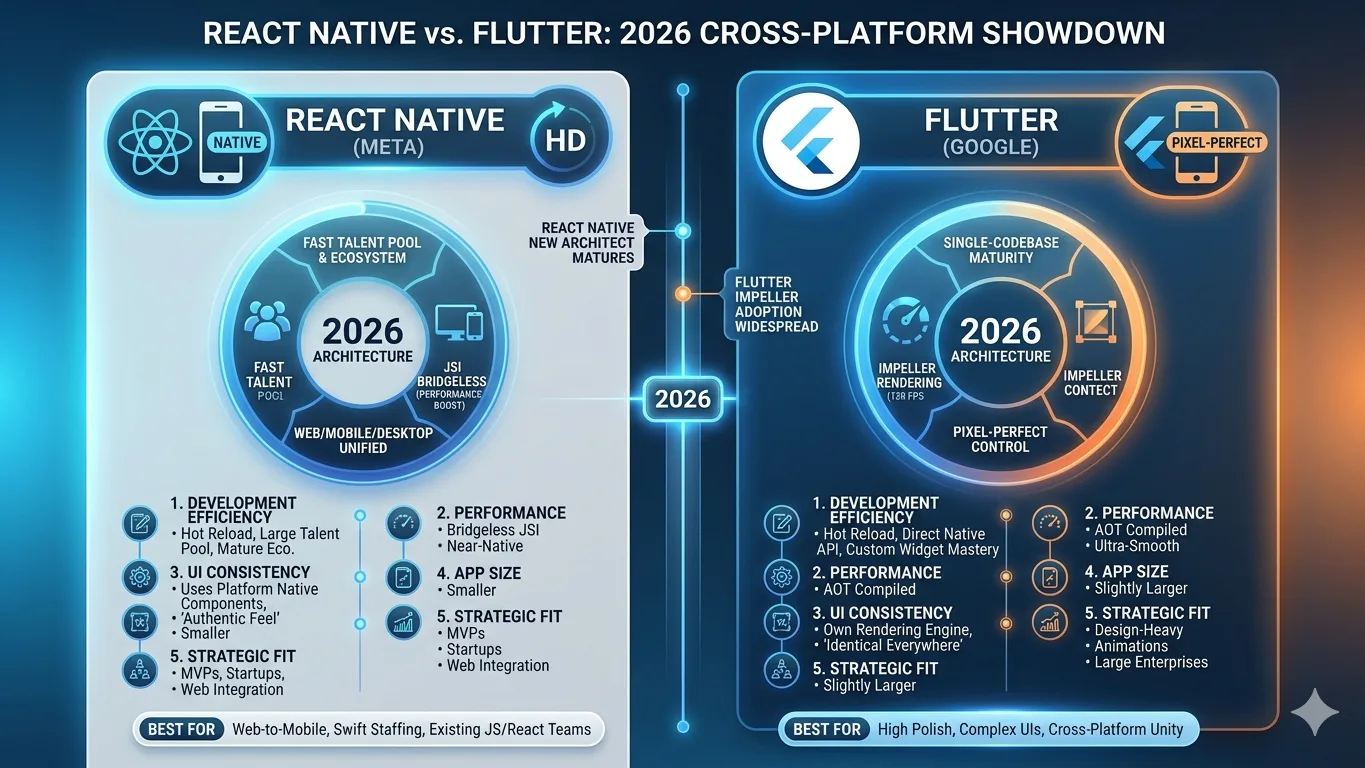
In the rapidly evolving world of mobile app development, one debate continues to dominate among startups, enterprises, and CTOs — React Native vs Flutter.
If you're planning to build a scalable cross-platform app in 2026, choosing the right framework can impact development speed, performance, maintenance costs, and time-to-market.
At Datasoft Technologies, we help startups and enterprises build high-performance digital products, and one of the most common questions we hear is:
Should we choose React Native or Flutter in 2026?
This detailed guide compares both frameworks across performance, scalability, developer ecosystem, UI flexibility, AI-readiness, and cost — helping you choose the right technology stack.
What is React Native?
Developed by Meta, React Native is a popular open-source framework for building native-like mobile apps using JavaScript and React.
Popular apps built using React Native:
- Shopify
- Discord
Key Benefits
- Large developer ecosystem
- Faster development cycles
- Code reusability
- Strong community support
- Easy integration with web stacks
What is Flutter?
Created by Google, Flutter uses the Dart language and its own rendering engine to build highly customized apps.
Popular apps using Flutter:
- Google Pay
- Alibaba
- BMW
Key Benefits
- Beautiful custom UI
- Excellent performance
- Single codebase for multiple platforms
- Faster rendering
- Strong support for embedded and web
React Native vs Flutter in 2026: Feature Comparison
1. Performance
Flutter Wins for Raw Performance
Flutter compiles to native code and uses its own rendering engine.
Better for:
- Heavy animations
- Gaming interfaces
- Complex dashboards
- High-performance apps
React Native
Excellent for most business apps but still depends on native bridges in some cases.
Winner: Flutter
2. Development Speed
React Native Wins
If your team already uses JavaScript/React, development can move extremely fast.
Ideal for:
- MVP development
- Startup products
- SaaS mobile apps
- Faster releases
Winner: React Native
3. UI and Design Flexibility
Flutter Leads
Flutter offers pixel-perfect custom UI.
Great for:
- Fintech apps
- Consumer apps
- Premium product experiences
Winner: Flutter
4. Ecosystem and Libraries
React Native Still Ahead
Because of JavaScript maturity and the React ecosystem.
Huge advantage in:
- Plugins
- Community packages
- Integrations
- Developer availability
Winner: React Native
React Native vs Flutter for Startups
For startups launching MVPs:
Choose React Native if you need:
- Faster go-to-market
- Lower development cost
- Easy scaling
- Web + mobile synergy
Choose Flutter if you need:
- Superior UI
- App performance focus
- Custom product experience
AI and Cross Platform Apps in 2026
With growing demand for AI app development, framework choice matters.
For AI-enabled mobile apps:
- Chatbot apps
- Recommendation engines
- AI assistants
- Computer vision products
Both support AI integrations, but React Native often has faster integration with JavaScript AI ecosystems.
React Native vs Flutter Cost Comparison
React Native Development Cost
Often lower because:
- Larger talent pool
- Faster hiring
- Faster development
- Easier maintenance
Flutter Development Cost
Can be higher for specialized work but may reduce performance optimization costs.
React Native vs Flutter for Enterprise Apps
For enterprise-grade products:
React Native works well for:
- Business apps
- Internal platforms
- SaaS products
- CRM/ERP mobility
Flutter excels in:
- Consumer products
- Visual-heavy apps
- Premium user experiences
2026 Trend: Which Framework Is Growing Faster?
Both are growing.
React Native Trends
Strong due to:
- Mature ecosystem
- Enterprise adoption
- React dominance
Flutter Trends
Strong due to:
- Multi-platform growth
- UI innovation
- Performance-focused applications
Truth:
There is no one-size-fits-all winner.
It depends on product goals.
Our Recommendation at Datasoft Technologies
At Datasoft Technologies:
Choose React Native for:
- Startup MVPs
- SaaS apps
- Business platforms
- Faster development cycles
Choose Flutter for:
- High-performance consumer apps
- Custom UI products
- Visually rich experiences
React Native vs Flutter Comparison Table
| FactorReact NativeFlutter | ||
| Performance | Good | Excellent |
| Development Speed | Excellent | Very Good |
| UI Flexibility | Good | Excellent |
| Ecosystem | Excellent | Very Good |
| Cost Efficiency | Excellent | Good |
| Enterprise Apps | Excellent | Very Good |
| Custom Graphics | Good | Excellent |
Which is Better in 2026?
If speed, ecosystem, and business scalability matter:
Choose React Native
If performance and custom UI matter:
Choose Flutter
The best framework depends on your product roadmap.
Why Businesses Choose Datasoft Technologies for Mobile App Development
- Cross-platform mobile apps
- Custom SaaS products
- AI-powered applications
- Startup MVPs
- Enterprise software solutions
Whether you choose React Native or Flutter, our team helps architect scalable products aligned to your business goals.
Looking to Build a Mobile App?
Contact Datasoft Technologies for:
- Mobile app consultation
- MVP development
- Flutter development services
- React Native development services
- Custom software solutions
FAQs
Is Flutter better than React Native in 2026?
Flutter often leads in performance and UI, while React Native remains strong for ecosystem and speed.
Which is cheaper: Flutter or React Native?
React Native is often more cost-effective due to developer availability.
Is React Native still relevant in 2026?
Absolutely. It remains one of the most used cross-platform frameworks.
Which framework is better for startups?
React Native is often preferred for startup MVP development.
Final Thoughts
The React Native vs Flutter debate in 2026 is less about “which is better” and more about which is right for your product.
If you want expert guidance on choosing the right stack, Datasoft Technologies can help you build scalable digital products faster.
SEO Keywords Targeted:
- React Native vs Flutter
- React Native vs Flutter 2026
- Flutter vs React Native performance
- Mobile app development company
- React Native development services
- Flutter app development company
- Cross platform app development
- Custom mobile app development
- AI mobile app development
If you want, I can also turn this into a high-ranking pillar blog with schema FAQ and featured snippet optimization for Datasoft.
make it ready to post on Blogs and Linkedin with high ranking SEO keywords
React Native vs Flutter in 2026: Which Framework Should Startups and Enterprises Choose for Mobile App Development?
In 2026, cross-platform mobile app development continues to dominate digital product strategy, and one question keeps surfacing:
React Native vs Flutter — which framework is better for building scalable mobile applications?
For startups, SMEs, and enterprises investing in mobile app development services, choosing the right framework impacts:
- Time-to-market
- Development cost
- App performance
- Scalability
- User experience
- Long-term maintenance
At Datasoft Technologies, we work with businesses globally on custom mobile app development, SaaS products, AI-powered applications, and enterprise software solutions, and this remains one of the most asked questions from founders and CTOs.
In this guide, we compare React Native vs Flutter in 2026 across performance, cost, scalability, developer ecosystem, and business suitability.
What is React Native?
React Native is an open-source cross-platform framework developed by Meta for building iOS and Android apps using JavaScript and React.
Why Businesses Choose React Native
- Faster MVP development
- Lower development costs
- Reusable codebase
- Strong developer ecosystem
- Easy integration with web applications
- Great for startup app development
Popular Apps Built with React Native
- Shopify
- Discord
For businesses seeking React Native app development services, it remains a strong technology choice in 2026.
What is Flutter?
Flutter, developed by Google, is a UI toolkit for building natively compiled applications using Dart.
Why Businesses Choose Flutter
- High-performance rendering
- Beautiful custom UI
- Faster animations
- Single codebase for multiple platforms
- Excellent scalability
Flutter has become a preferred framework for visually rich and performance-heavy applications.
React Native vs Flutter in 2026 — Detailed Comparison
1. Performance
Flutter Leads
Flutter compiles directly to native code and offers strong rendering performance.
Best suited for:
- Fintech apps
- Enterprise dashboards
- On-demand apps
- Complex mobile applications
Winner: Flutter
2. Development Speed
React Native Wins
For startups and SaaS products requiring rapid launch, React Native remains extremely efficient.
Ideal for:
- MVP development
- Startup mobile apps
- Business applications
- Faster product launches
Winner: React Native
3. UI and User Experience
If custom user interfaces are a priority:
Flutter has the edge.
Ideal for:
- Premium product experiences
- Consumer apps
- Highly customized interfaces
Winner: Flutter
4. Developer Ecosystem
React Native still benefits from the massive JavaScript ecosystem.
Advantages:
- More libraries
- Larger talent pool
- Easier hiring
- Mature community support
Winner: React Native
React Native vs Flutter for Startups
For startups building MVPs in 2026:
Choose React Native if you need:
✔ Faster development
✔ Lower budget
✔ Faster product validation
✔ Easy scaling
Choose Flutter if you need:
✔ Custom UI-heavy products
✔ Superior animation performance
✔ High-end consumer experiences
React Native vs Flutter for Enterprise Applications
For enterprise software and scalable platforms:
React Native is strong for:
- Business process apps
- HRMS apps
- CRM/ERP mobility
- SaaS mobile platforms
Flutter excels for:
- Advanced enterprise dashboards
- Performance-intensive products
- Premium digital experiences
Cost Comparison: React Native vs Flutter
React Native Development Cost
Often lower due to:
- Large developer availability
- Faster onboarding
- Lower maintenance overhead
Flutter Development Cost
Potentially higher for specialized development, but strong in performance optimization.
For many startups, React Native development can be more cost-efficient.
AI-Powered Mobile Apps in 2026
With rising demand for AI app development, both frameworks support:
- AI chatbots
- Recommendation engines
- Predictive systems
- Generative AI integrations
For businesses investing in AI mobile app development, framework selection should align with product architecture.
React Native vs Flutter Comparison Table
| FeatureReact NativeFlutter | ||
| Performance | Very Good | Excellent |
| Development Speed | Excellent | Very Good |
| UI Flexibility | Good | Excellent |
| Ecosystem | Excellent | Very Good |
| Cost Efficiency | Excellent | Good |
| Enterprise Readiness | Excellent | Excellent |
Which Framework Should You Choose in 2026?
Choose React Native if you need:
- Faster go-to-market
- Lower development costs
- Startup MVP development
- Scalable business applications
Choose Flutter if you need:
- Superior UI
- High performance
- Rich visual experiences
- Complex consumer applications
There is no universal winner — only the right choice for your business goals.
Why Businesses Choose Datasoft Technologies for Mobile App Development
At Datasoft Technologies, we help startups and enterprises build:
- Cross-platform mobile apps
- Custom SaaS products
- AI-powered applications
- Enterprise mobility solutions
- React Native development projects
- Flutter app development solutions
Whether you need React Native development services or Flutter app development, our team helps choose and build the right architecture.
Final Verdict: React Native vs Flutter in 2026
If you prioritize:
Speed + Ecosystem + Cost Efficiency
→ Choose React Native
If you prioritize:
Performance + Custom UI + Rich UX
→ Choose Flutter
The best framework is the one aligned with your product strategy.
Looking to Build a Mobile App in 2026?
Need help choosing between React Native and Flutter?
Datasoft Technologies can help you build scalable mobile applications, SaaS products and AI-driven digital solutions.
📩 Contact us for a free consultation.